

 Back to Madeira Insider
Nature & Wildlife
Why sunrise and sunset at Pico do Areeiro can look hazy, pale or disappear
The mountain is reliable. The sky is not. Here is what actually decides whether you get fire in the clouds or a flat grey nothing.
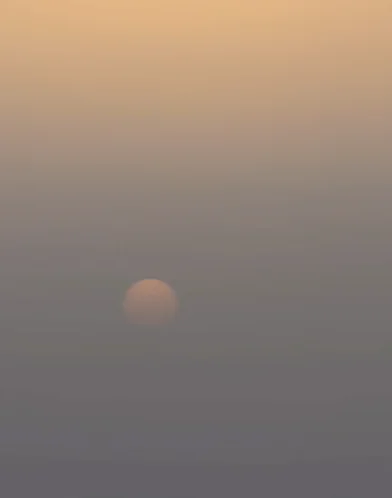
Pico do Areeiro is one of the most photographed viewpoints in Madeira, and one of the most unpredictable. Some mornings the sun breaks through a sea of clouds in sharp, saturated colour. Others, it rises as a pale disc behind a wall of grey haze, or does not really appear to rise at all. The mountain and the timing are the easy part. The sky is the variable, and it is shaped by dust, moisture and air layers that have nothing to do with the calendar.
In short
A hazy, pale or washed-out sunrise or sunset at Pico do Areeiro is usually caused by Saharan dust, marine haze, high humidity or a thin cloud layer sitting over the sun's path. Madeira's temperature inversion, the same layer that produces the famous cloud waterfalls, can trap this haze close to the horizon. None of this is a malfunction of the view. It is normal Atlantic and North African atmosphere, and it varies from one morning to the next, sometimes from one hour to the next.
Saharan dust can change the sky
Madeira sits in the Atlantic within reach of the Saharan Air Layer, a mass of warm, dry air carrying fine mineral dust that lifts off the Sahara and travels west over the ocean. When a plume of this dust passes over the archipelago, it scatters sunlight differently from clean air. Depending on its density and the angle of the sun, the effect ranges from a soft golden haze to a flat, milky sky that mutes the colour almost completely. This is the same phenomenon that produces hazy horizons and reduced visibility across the Canary Islands and much of the eastern Atlantic during dust events, and Madeira is close enough to feel it regularly, not just as a rare occurrence.
Why warm weather and dusty skies sometimes arrive together
Saharan dust plumes are frequently carried on the same weather systems that bring warmer, drier air to Madeira, so a hot, still spell and a hazy sky often show up in the same window. It is tempting to conclude that the heat itself is dulling the sunrise, but the two are travelling together rather than one causing the other. The warmth is a symptom of the air mass; the haze is the dust suspended within it. On a warm day with clean air and no dust plume, colours at sunrise and sunset can still be sharp and saturated. The heat is a clue worth noticing, not a rule to rely on.
Madeira's temperature inversion also matters
Madeira's mountains regularly sit above a temperature inversion, a layer where air temperature rises with altitude instead of falling. It is the same mechanism behind the island's famous cloud waterfalls, where a sea of cloud pools in the valleys below while the peaks stay clear. That same inversion layer traps moisture, marine haze and any dust in suspension close to sea level, right where the sun rises and sets. From Pico do Areeiro, at 1,818 metres, this can mean a clear sky directly overhead while the horizon itself sits behind a dense, low band of haze. The summit view can be spectacular and the sunrise itself still look pale, because the two are governed by different layers of the same atmosphere.
Dust does not always create a colourful sunrise or sunset
There is a common assumption that atmospheric dust automatically means a more dramatic, fire-coloured sky. Sometimes it does: a moderate, well-dispersed dust layer can scatter light into deep oranges and reds. But a dense, low plume can just as easily flatten the whole scene into pale grey or washed-out white, with the sun barely visible as a dim disc. The outcome depends on the concentration of dust, its altitude and how it is layered against any cloud that is also present, which is why the same dust event can produce a striking sunset in one location and a dull one a short distance away.
Other reasons why visibility can be poor
Dust is not the only variable. Marine haze, a fine suspension of salt and moisture off the Atlantic, regularly sits along the horizon even on dust-free days. High humidity thickens the lower atmosphere and softens contrast well before any cloud becomes visible to the eye. A thin, high veil of cirrus can mute a sunset without ever looking like a proper cloud cover from the ground. And the inversion layer itself can hold ordinary moisture and light pollution from the coast close to the horizon, independent of any dust arriving from Africa. In practice, most disappointing sunrises are a combination of two or three of these factors rather than any single dramatic cause.
Can you predict the colours?
Only loosely. Saharan dust events are tracked by regional air quality and aerosol forecasts, and a visible dust plume in the forecast is a reasonable signal that the sky will look different from a clean-air morning, for better or worse. A cloud sea below the summit, clear skies overhead and light wind are generally good conditions for a vivid sunrise, but none of these guarantee saturated colour, and a seemingly perfect forecast can still produce a flat one. The honest answer is that Pico do Areeiro rewards patience and repeat visits far more than any single forecast check.
Sunrise and sunset are atmospheric events, not guaranteed photographs
It is worth resetting the expectation before the trip rather than after it. A sunrise at Pico do Areeiro is a live atmospheric event, shaped by dust, moisture, wind and cloud that shift hour to hour and are never fully guaranteed by a forecast. The clear, saturated version seen in photographs is real and does happen, but so is the pale, hazy version, and neither reflects badly on the location or the timing. Travellers who build in a second morning, or who treat the summit itself, the cloud sea and the walk as the experience rather than betting everything on one specific colour palette, tend to come away satisfied either way.
Frequently asked questions
Is a hazy sunrise more common in summer?
Saharan dust events can happen across the year, though they are often more talked about in warmer months because dusty air masses and summer heat frequently arrive together. It is not a winter-only or summer-only phenomenon.
Does a hazy sunrise mean the cloud sea will also be poor?
Not necessarily. The cloud waterfall below the summit and the colour of the sunrise are influenced by related but distinct conditions, so it is possible to have a spectacular sea of clouds under a relatively pale sky, or the opposite.
Can I check conditions before going up?
Regional aerosol and air quality forecasts can flag an active Saharan dust plume, and general cloud-cover and humidity forecasts help too, but neither guarantees the exact colour of the sky on the day.
Is sunrise or sunset more reliable for colour?
Neither is inherently more reliable. A weak sunrise and a strong sunset can happen on the same day, and the reverse is just as common, since conditions can shift meaningfully within a single day.
Planning a sunrise or sunset visit to Pico do Areeiro? Our guides track conditions, choose the best available morning within your stay, and handle transport and timing so you are in the right place when the sky cooperates.
See Nature & WellnessRelated reading
For more on how Madeira's weather changes across short distances, see our guide to Madeira's microclimates. If you are planning the classic ridge walk itself, our guide to the PR1 Pico do Areeiro to Pico Ruivo trail covers the route in full. And for choosing when to travel more broadly, see the best time to visit Madeira & Porto Santo.