

 Back to Madeira Insider
Travel Tips
Landing in Madeira: the airport, transfers, and what happens when the wind wins
A runway on 180 pillars over the Atlantic, and what to do if yours diverts.
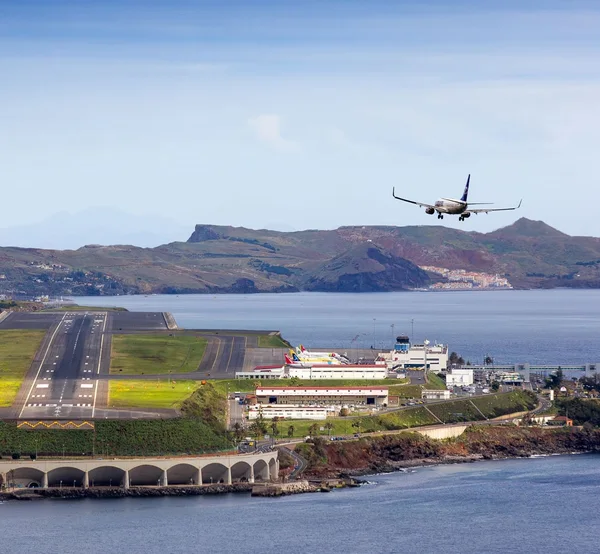
Cristiano Ronaldo Madeira International Airport (FNC) sits in Santa Cruz, around 20 km east of Funchal, and its runway extends over the Atlantic on 180 concrete pillars. It is one of the most challenging airports in Europe, and this guide covers how to get to Funchal, why flights divert, and exactly what to do if yours does.
In short
Cristiano Ronaldo Madeira International Airport (FNC) sits in Santa Cruz, around 20 km east of Funchal, and its runway extends over the Atlantic on 180 concrete pillars. It is one of the most challenging airports in Europe, and on windy days flights are delayed, go around, or divert, most often to Porto Santo, Tenerife, Las Palmas or Lisbon. Transfers to Funchal take 20 to 25 minutes: the aerobus costs around €5, Bolt or Uber roughly €18 to €28, and a taxi around €25 to €35 depending on the time of day. There is no ferry from mainland Portugal. Everyone arrives by air.
The airport, in context
FNC opened in 1964 with a runway of only 1,600 metres, and the extension over the sea, supported on pillars, is what made modern aviation possible here. It is the fourth busiest airport in Portugal, and in January of 2025 and 2026 it overtook Faro. It is also, quite genuinely, one of the world's more demanding approaches: the runway sits beside cliffs and the ocean, and the wind direction decides whether your flight lands, holds, or goes elsewhere.
None of this should worry you. The pilots who fly here hold specific certification for this airport, and the vast majority of flights land normally. But it does mean the wind is a variable worth planning around, in a way it is not at most destinations.
Getting from the airport to Funchal
| Option | Time | Approximate cost | Notes |
|---|---|---|---|
| Aerobus | 30 to 40 min | ~€5 | Cheapest, stops along the Funchal seafront |
| Bolt or Uber | 20 to 25 min | ~€18 to €28 | Works well, clear pricing, available at the airport |
| Taxi | 20 to 25 min | ~€25 to €35 | Official rank outside arrivals, yellow cars with a blue stripe |
| Private transfer | 20 to 25 min | Varies | Pre-booked, meets you in arrivals, monitors your flight |
| Rental car | 20 to 25 min | From ~€30 a day | Read our honest article on whether you actually need one |
For late-night arrivals, families with a lot of luggage, or anyone landing after a long day, a pre-booked transfer that tracks the flight is worth the difference. It is also the option that does not care whether you land forty minutes late.
Why flights divert, and what actually happens
Madeira's runway is exposed to strong crosswinds off the ocean. When the gusts exceed the safety limits, aircraft hold, go around, or divert. This is not rare drama: in June 2026 alone, several consecutive days saw significant disruption, with gusts reaching 94 km/h and, on the worst day, twenty-two passenger flights cancelled.
Where flights divert to: most commonly Porto Santo (the neighbouring island), Tenerife or Las Palmas in the Canaries, or Lisbon and Porto on the mainland. Airlines usually try to operate the flight again once the wind eases, sometimes within hours.
What you are entitled to. Because weather is outside the airline's control, compensation under EC 261 is usually not payable. But the airline still owes you care and assistance: meals and refreshments, hotel accommodation if you are stranded overnight, transport to that accommodation, and either a re-route or a refund if you choose not to continue. Knowing that distinction saves a lot of frustration at a service desk.
What to do in the moment
- Contact your airline first, not the airport. The airline owns your re-routing.
- Keep receipts for anything you pay for while stranded.
- If you have a transfer or tour booked, message the operator immediately. Any decent local operator will rearrange rather than charge you for a no-show.
- Do not book the tightest possible onward connection out of Madeira. Leave a buffer.
Practical arrival notes
- Check before you travel. ANA, the airport operator, advises contacting your airline before heading to the airport when adverse weather is forecast. On unstable days, that advice is worth taking literally.
- Arrivals hall is small. Meeting points are easy; there is no realistic chance of missing a driver holding a sign.
- Currency and connectivity. Euro, ATMs in the terminal, EU roaming applies as it is Portugal.
- Porto Santo connection. The inter-island flight leaves from here (around 25 minutes), while the ferry leaves from Funchal harbour, not the airport. They are two different places, roughly half an hour apart.
- The webcam. There is a live webcam at the airport, and watching landings on a windy day is a local spectator sport. Enjoy it after you have landed, not before you fly.
Frequently asked questions
Is Madeira airport dangerous?
It is demanding, not dangerous. Pilots require specific certification for this approach, and safety limits are the reason flights divert rather than attempt a risky landing. The diversion is the system working, not failing.
How likely is my flight to divert?
On the great majority of days, not at all. Disruption clusters on windy days, more common in winter and during unstable spells, and the airport publishes conditions in real time.
Can I get from the airport to Porto Santo directly?
Yes, by the inter-island flight, around 25 minutes. The ferry goes from Funchal harbour, which is a separate journey.
Is there a ferry from mainland Portugal?
No. Every visitor arrives by air.
Should I book a transfer in advance?
For late-night arrivals, groups, or if you want your driver to still be waiting when the wind delays you by two hours, yes.
Our private transfers monitor your flight and adjust to it, including when the wind decides otherwise. Tell us your arrival details and we handle the rest.
Talk to us